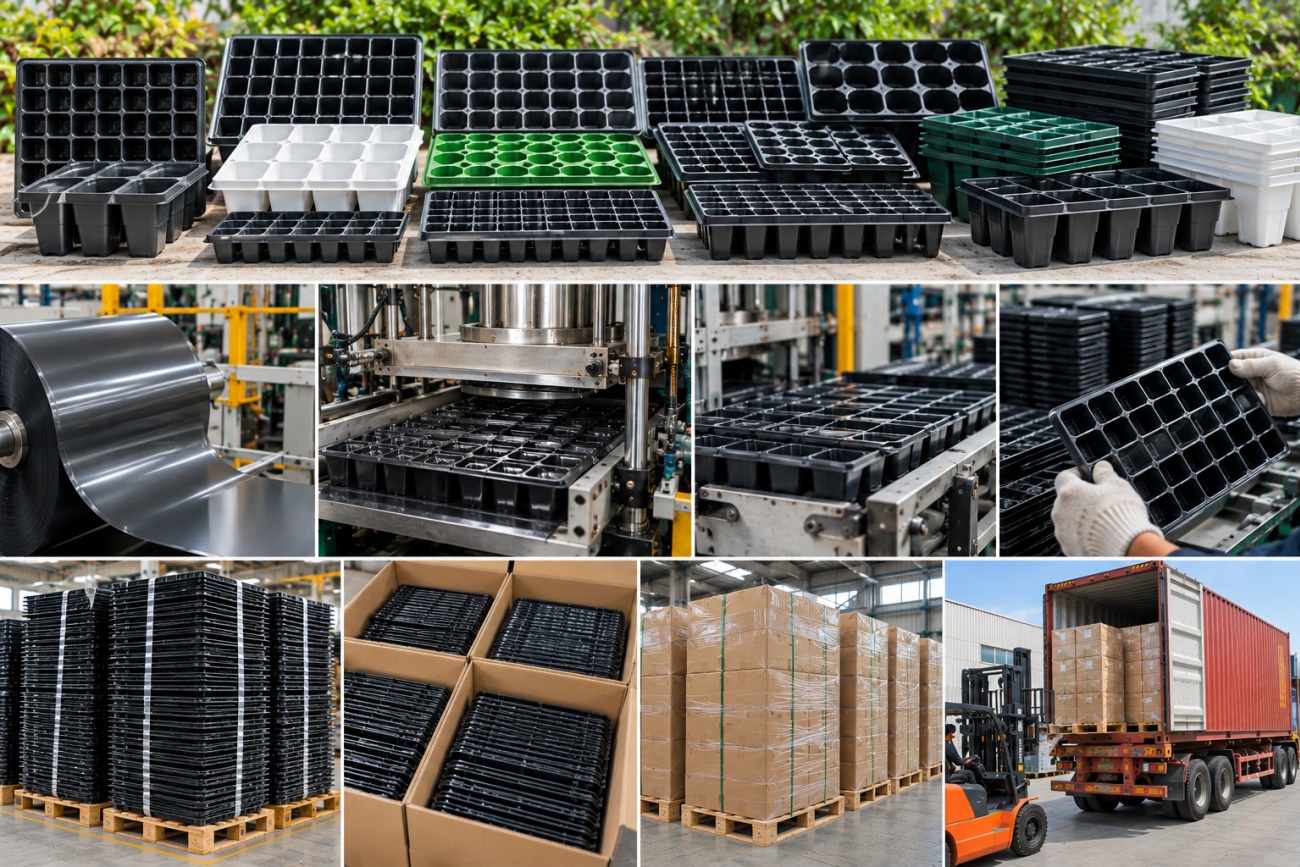
Seedling Tray Options for Custom and Wholesale Orders
Seedling trays are used for seed germination, plug plant production, greenhouse propagation, and transplant preparation. Different cell counts and cavity depths help growers select suitable trays for their crops, growing media, and propagation equipment.
Potsenra coordinates wholesale supply and feasible OEM modifications through manufacturing partners. Buyers should consider tray rigidity, root development space, drainage, and compatibility with existing nursery handling systems.
Key Options
-
Cell Configurations: Different plug counts and cavity layouts.
-
Tray Dimensions: Standard and application-specific tray formats.
-
Cell Shapes: Round, square, and tapered cavities.
-
Materials: PS, PP, PET, or suitable plastic sheets.
-
Tray Construction: Lightweight or reinforced designs.
-
Drainage: Bottom openings and suitable cell base structures.
Custom Seedling Tray Support
Seedling tray customization should focus on propagation requirements and compatibility with nursery equipment. Changes to cavity geometry or tray dimensions may require new forming molds.
Potsenra can discuss the following OEM requirements:
-
Tray Dimensions: Overall length, width, and cell layout.
-
Cell Design: Cavity count, depth, shape, and drainage openings.
-
Material & Thickness: Plastic selection, sheet thickness, and color.
-
Branding: Product labels, barcode stickers, or suitable identification marks.
-
Private Label Packaging: Custom labels, carton markings, and export packaging.
Custom tooling and non-standard configurations may require sample development and approval before bulk production.
Specifications and Buying Information
For commercial propagation, tray specifications should match the intended growing process. Cell count alone is insufficient for selecting a suitable product.
Important purchasing information includes:
-
Overall Dimensions: Tray length, width, and height.
-
Cell Configuration: Number of cells, cavity dimensions, and depth.
-
Cell Volume: Approximate growing media capacity per cavity.
-
Material & Thickness: Plastic type, sheet thickness, and tray weight.
-
Drainage: Hole dimensions and bottom design.
-
Compatibility: Nursery benches, handling equipment, and transplanting systems.
-
MOQ & Samples: Depend on tray design, mold availability, and customization.
-
Lead Time: Confirmed according to specifications and order quantity.
Approved samples are recommended for equipment compatibility checks.
Production and Quality Checks
Many plastic seedling trays are manufactured through sheet extrusion and thermoforming, while some rigid designs may use injection molding.
Potsenra coordinates relevant production requirements and quality checks with manufacturing partners according to the selected product.
Typical inspection points include:
-
Material Inspection: Plastic type, color, and sheet consistency.
-
Forming Quality: Cavity shape, depth, and uniformity.
-
Dimensions: Overall tray size, cell spacing, and thickness.
-
Drainage Openings: Hole formation and removal of obstructing plastic.
-
Structural Condition: Cracks, deformation, and handling rigidity.
-
Stacking Performance: Nesting consistency and separation.
-
Final Inspection: Product quantity, appearance, and packaging accuracy.
Additional handling or equipment compatibility checks can be agreed upon before production.
Packaging Options
Plastic seedling trays are usually nested to reduce shipping volume and simplify warehouse handling. Packing arrangements depend on tray dimensions, material thickness, and structural rigidity.
Common options include:
-
Nested Stacks: Agreed quantities per stack.
-
Protective Wrapping: Film or suitable wrapping for bulk bundles.
-
Bulk Cartons: Export cartons for wholesale distribution.
-
Custom Labels: Product identification, cell count, and barcode stickers.
-
Private Label Packaging: Custom carton markings and approved packaging designs.
-
Export Preparation: Palletizing, stretch wrapping, and container loading arrangements.
Stack height and carton quantities should be confirmed to reduce deformation during transportation.
What We Need for a Quote
Please provide the following details for your seedling tray inquiry:
-
Product Style or Reference Photo: Preferred propagation tray design.
-
Size / Specification: Overall dimensions, cell count, and cavity depth.
-
Material & Thickness: Preferred plastic type and sheet thickness.
-
Quantity: Estimated pieces per tray configuration.
-
Logo File or Artwork: If labeling or branding is required.
-
Packaging Request: Nested bundles, cartons, or private label packaging.
-
Destination Country: Country and receiving port, if available.
-
Shipping Term: EXW, FOB, CIF, or another requested term.
Related Categories
-
Plastic Nursery Pots — Individual growing containers for transplanting and nursery production.
-
Plastic Pots — General planting containers for greenhouse and garden supply.
-
Grow Bags — Flexible containers for growing vegetables, herbs, and established plants.
-
Large Plastic Pots — Larger containers for subsequent plant growth.
-
Plastic Hanging Baskets — Hanging containers for flowering plants and garden retail.
Seedling Tray FAQ
What is the MOQ for wholesale seedling trays?
MOQ depends on tray dimensions, cell configuration, material, thickness, and mold availability. Standard trays and custom propagation designs may have different minimum quantities. Contact us with your required specifications for confirmation.
Can seedling trays be customized with different cell counts and sizes?
Different cell configurations, cavity depths, and tray dimensions can be discussed. Existing molds may limit available options, while special layouts may require new tooling and sample approval.
Can we request seedling tray samples before bulk ordering?
Sample requests can be reviewed for existing designs and custom configurations. We recommend checking tray dimensions, cell depth, drainage, and compatibility with your propagation equipment before confirming production.
How do you inspect plastic seedling trays?
Relevant inspection points include overall dimensions, cavity consistency, plastic thickness, drainage openings, deformation, and stacking performance. Inspection requirements can be agreed upon using approved product samples.
How are seedling trays packed for export?
Seedling trays are commonly nested and packed in bundles or cartons. Protective wrapping, carton quantities, pallet arrangements, and export markings depend on the selected tray design and shipping requirements.
Request a Seedling Tray Quote
Looking for plastic seedling trays for commercial propagation, greenhouse production, or wholesale distribution?
Contact Potsenra Plastic Pots with your required tray dimensions, cell count, cavity depth, material, thickness, and estimated quantities. Include packaging requirements, branding artwork, and destination details where applicable.
We will review available designs, customization feasibility, sample requirements, and quotation information for your order.